

We’ve all been there: you’re in the middle of a conversation, everything’s flowing smoothly, and suddenly you forget how to say a Spanish word. ¡Qué bajón!
Forgetting your Spanish vocabulary can be frustrating, especially when you’re trying to maintain fluency and keep the conversation going. But don’t worry, there are some nifty techniques you can master to get around this hiccup.
In this blog post, we’ll discuss three effective strategies to help you out when you forget how to say a Spanish word. Use these strategies to stay confident when you speak Spanish during a lesson or have a conversation with a native.

What Are the Best Strategies to Keep the Conversation Flowing?
1. Describe the Words and Phrases
When you forget how to say a Spanish word, one of the most effective techniques is to describe what you’re trying to say.
I am not saying this is an easy task, but it is definitely going to help you learn Spanish faster.
For example, if you can’t remember the word for “fork” (tenedor), you can describe it as “el utensilio que usás para comer” (the utensil you use to eat). This way, you’re still communicating your idea without halting the conversation.
Key Words for Better Descriptions
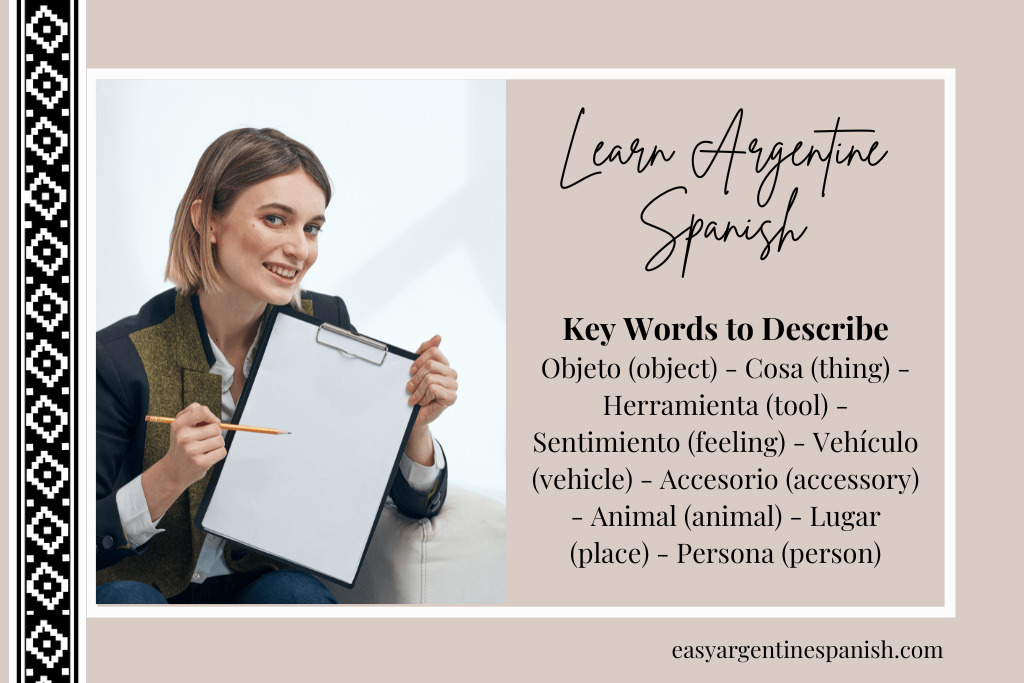
Here are a number of common Spanish words that can ease the description process:
Objeto (object) – Cosa (thing) – Herramienta (tool) – Sentimiento (feeling) – Vehículo (vehicle) – Accesorio (accessory) – Animal (animal) – Lugar (place) – Persona (person)
See them in context:
- Un objeto que se usa para cantar. (El micrófono).
- Una cosa que se usa para secarse el cuerpo después de la ducha. (Una toalla).
- Una herramienta que se usa para ajustar o aflojar tuercas. (La llave inglesa).
- Un sentimiento que sentimos cuando estamos muy enojados. (La ira).
- Un vehículo que se usa para transportar cargas pesadas. (Un camión).
- Una prenda que se usa alrededor del cuello cuando hace frío. (Una bufanda).
- Un animal que da leche y queso y es sagrado en la India. (La vaca).
- Un lugar con tiendas de ropa, comercios, restaurantes y cine. (El shopping).
- Una persona que limpia casas. (El/La empleado/a de la limpieza).
2. Use Synonyms or Related Words
Another handy trick for when you forget how to say a Spanish word is to use a synonym or a related word.
If you can’t recall the word for “beach” (playa), you might use “costa” (coast) or “mar” (sea) instead.
While it might not be the exact word you were aiming for, it keeps the conversation going.
Often, the person you’re talking to will understand what you mean and might even supply the word you were looking for. When this happens, make sure to repeat that word several times in the conversation to make sure the brain remembers it.
My favorite tool when I can’t think of a synonym is the WordReference online dictionary. Make sure to select “Spanish synonyms”.

3. Gestures and Body Language
Sometimes, non-verbal communication can save the day when you forget how to say a Spanish word.
Gestures and body language can be incredibly powerful in conveying meaning.
If you forget the word for “drink” (bebida), miming the action of drinking from a glass can help get your point across. This technique not only helps you communicate but also makes the conversation more engaging and interactive.
Important Argentine Body Language
Here are five Argentine gestures and their meanings that can help you express what you want to say without saying a word:
1. Fingers together, moving up and down: This gesture is made with the fingers of one hand together, pointing upwards, and moving them quickly up and down. It means “What’s going on?” or “What do you want?” and is used to express surprise, confusion, or annoyance.
2. Touching the elbow with the opposite hand: This gesture is used to indicate that someone is stingy or cheap. Touching the elbow with the opposite hand is a subtle way to suggest that a person doesn’t want to spend money.
3. Hitting the palm of one hand with the back of the other: This gesture is used to indicate that something is very expensive or costs a lot of money. The open hand is hit with the back of the other hand, as if you were counting money.
4. Waving the hand side to side in front of the face: With the hand open and fingers together, it’s waved from side to side in front of the face. This gesture means “No way!” or “Not a chance!” and is used to emphatically reject something.
5. Thumb up and then towards the mouth: This gesture is done by lifting the thumb and then moving it towards the mouth as if you were drinking. It means “Let’s have a drink” or “Do you want to drink something?” and is used to invite someone to have a beverage, usually an alcoholic one.
These gestures are part of Argentine body language and are commonly used in everyday life. Practice these gestures and you’ll feel more connected to the local culture!

Practice Makes Perfect
Remember, forgetting how to say a Spanish word is a common part of the language learning process. It happens to everyone, even fluent speakers.
The key is to stay calm and use these techniques to keep the conversation flowing. The more you practice, the easier it will become to navigate these moments smoothly.
To avoid forgetting how to say a Spanish word in the future, immerse yourself in the language as much as possible.
Listen to Spanish music, watch Argentine movies, read books, and most importantly, practice speaking with native speakers. This exposure will help reinforce your vocabulary and improve your overall fluency.
Conclusion
In conclusion, forgetting how to say a Spanish word doesn’t have to disrupt your conversation. By describing the word, using synonyms or related words, and incorporating gestures, you can stay fluent and keep the communication going.
Keep practicing the Spanish language and soon, these techniques will become second nature, helping you navigate any conversation with confidence. ¡Buena suerte, che!