

Learning the names of the days of the week in Spanish may appear straightforward, yet it holds its complexities. Today, I’m excited to share valuable tips to ensure you never forget the names of the days of the week in Spanish.
I vividly recall a student who once mixed up “viernes” (Friday) with “viento” (wind), leading to amusing yet significant misunderstandings. Such anecdotes highlight the importance of building a solid Spanish foundation.
When delving into a new language, the days of the week stand as among the initial milestones. In Spanish, while the names of the days of the week are relatively simple to grasp, committing them to memory poses a challenge. Thus, having a reliable guide becomes invaluable.

All the Days of the Week in Spanish
Let’s explore the names of the days of the week in Spanish:
– lunes (Monday)
– martes (Tuesday)
– miércoles (Wednesday)
– jueves (Thursday)
– viernes (Friday)
– sábado (Saturday)
– domingo (Sunday)
Spelling
Notably, in Spanish, days of the week are not capitalized unless they initiate a sentence.

Mnemonic Aid: Never Forget Weekdays
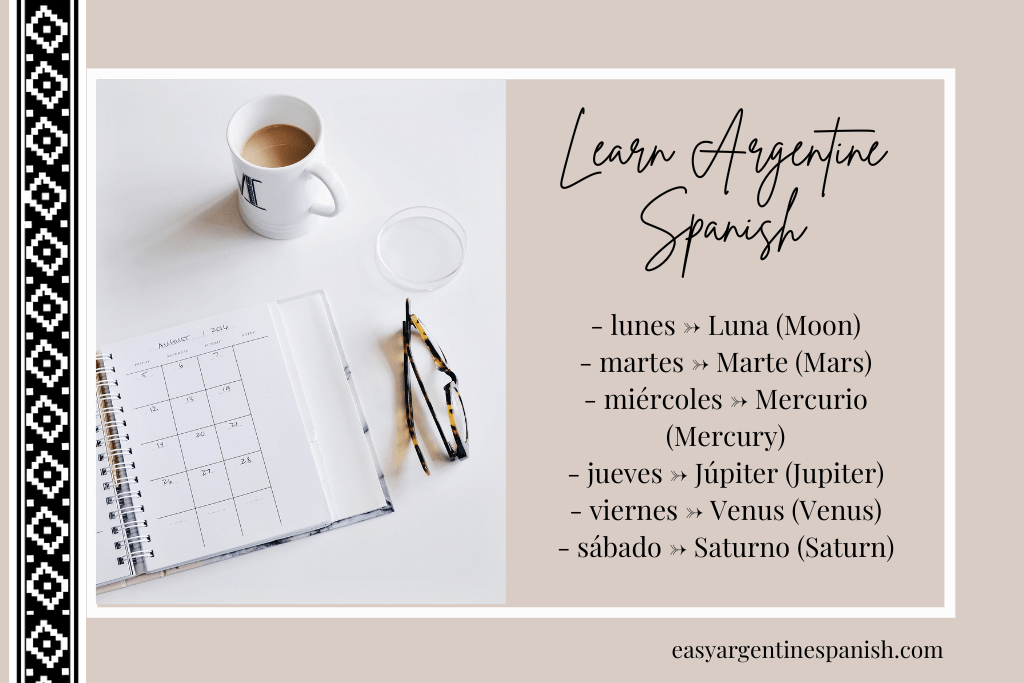
To ensure perpetual recall of the names of the days of the week in Spanish, consider this mnemonic aid: they align with celestial entities familiar to us all:
– lunes → Luna (Moon)
– martes → Marte (Mars)
– miércoles → Mercurio (Mercury)
– jueves → Júpiter (Jupiter)
– viernes → Venus (Venus)
– sábado → Saturno (Saturn)
– domingo → Sol (Sun) (Sunday)
The etymology behind “domingo” and “sábado” is rooted in Christian and Hebrew traditions. Both sábado and domingo form “el fin de semana” or “el finde” (the weekend).
How to Pronounce the Days of the Week
Now, let’s delve into pronunciation:
– Lunes (Monday) – /loo-nes/
– Martes (Tuesday) – /mar-tes/
– Miércoles (Wednesday) – /mee-air-coh-les/
– Jueves (Thursday) – /hoo-eh-ves/
– Viernes (Friday) – /vee-air-nes/
– Sábado (Saturday) – /sah-bah-doh/
– Domingo (Sunday) – /doh-meen-goh/
Mastering Spanish vowels’ pronunciation is key to accurately articulating the names of the days of the week.
Is “el lunes” the Same as “los lunes”?
When native speakers refer to a day of the week in plural, as in los lunes, los martes, los miércoles, we refer to every Monday, every Tuesday, every Wednesday, and so on. If someone says “el martes” or “el lunes” with the article “el”, it usually means next Tuesday, next Monday. See examples below.
Los domingos no cocino. (On Sundays I do not cook)
Los lunes salgo del trabajo antes. (On Mondays I get out of work earlier.)
El martes voy a verte. (On Tuesday I am seeing you.)
El jueves que viene vamos al boliche. (Next Thursday we are going to the club.)

Conclusion
In conclusion, familiarity with the names of the days of the week in Spanish is a cornerstone of language acquisition. Whether planning travels or honing language skills, this knowledge proves invaluable.
At our premium memberships, we believe in providing holistic language learning experiences. Our conversational lessons, held on Zoom from Monday to Thursday, are designed to immerse you in Spanish language and culture
In addition to our engaging conversational lessons, our premium memberships offer a wealth of resources to support your language journey. From grammar activities to bonus podcast episodes and video lessons, we’re committed to providing you with comprehensive learning materials.
As a premium member, you’ll also gain access to “Matecitos,” our exclusive private podcast featuring authentic conversations between two or more native speakers. Each episode offers a glimpse into real-life dialogue, helping you improve your listening comprehension skills in context.
Don’t let mispronunciations hold you back from mastering the names of the days of the week in Spanish. Join our premium memberships today and embark on a journey to fluency. With our expert guidance and comprehensive resources, you’ll soon be speaking Spanish with confidence and ease! Start your 7 day free trial TODAY!
¿Cuál es tu día de la semana favorito? Dejame un comentario abajo.