

How is Argentinian Spanish different from Chilean Spanish? Argentina and Chile are side by side at the very end of South America. Both countries share Spanish as their primary native language. However, there are major differences in the way natives speak.
When learning Spanish, it’s fascinating—and a little frustrating—to see how the language varies across different countries.
For Spanish learners, these differences can be really confusing. For instance, common expressions in Chile can make absolutely no sense in its neighbor country, Argentina.
- Chilean Spanish Coach Takes Over
- Spanish in Argentina vs Chile: 3 Key Differences

Chilean Spanish Coach Takes Over
To better explain the key differences that highlight the unique characteristics of these two Spanish variants, I’ve decided to bring a native Chilean to the blog.
Neurolanguage coach Natalia Fontalva from “Español Casi Perfecto” is here to answer some questions about how people speak Spanish in Chile.
Spanish in Argentina vs Chile: 3 Key Differences
1) Do people use ‘vos’ in Chile?
The story of “voseo” in Chile is pretty interesting. Back in the late 19th century, there were
campaigns and educational reforms aimed at removing it from our Spanish and promoting the use of “tuteo” instead. Somehow, this worked in written language, but we still use it in speech.
But, but, but… Our voseo is mostly used in informal, casual, and friendly contexts, and it’s not as widespread as in other Latin American countries. So, you’re unlikely to hear it on Chilean TV news.
Another key point is that in Chile, to keep the voseo friendly, we conjugate verbs the way we normally would with “vos,” but using the pronoun “tú.” Before you start scratching your head, let me explain:
Voseo Chileno
A. Verb “hablar” (to speak) → Vos habláis → -ais → Tú hablái (no ‘s’)
B. Verb “tener” (to have) → Vos tenéis → -éis → Tú tení (aspirated ‘s’)
C. Verb “vivir” (to live) → Vos vivís → -ís → Tú vivís (aspirated ‘s’)
Here in Chile, we use voseo in almost all verb conjugations, except in future forms (simple and compound) and in the imperative.
Here’s a quick rundown with the verb “cantar” (to sing):
| Presente de indicativo. | Pretérito imperfecto de indicativo. | Condicional simple. | Presente de subjuntivo. | Imperfecto de subjuntivo. |
| Tú cantái | Tú cantábai | Tú cantaríai | Tú cantís | Tú cantaríai |
Just a heads up, using “vos” in Chile—actually pronounced “voh”—can come off as rude or challenging if you’re not clear on the context and don’t have the right level of familiarity. So, I suggest sticking with “tú + voseo conjugation” to avoid any issues.
In summary, voseo in Chile is a friendly and colloquial way of speaking that differs from its broader use in other Latin American countries. While there were attempts to eliminate it in the past, it remains a part of our spoken communication and linguistic identity. Just be aware of the right context to use it.
1.1) Is ‘vos’ used differently in Argentine Spanish?
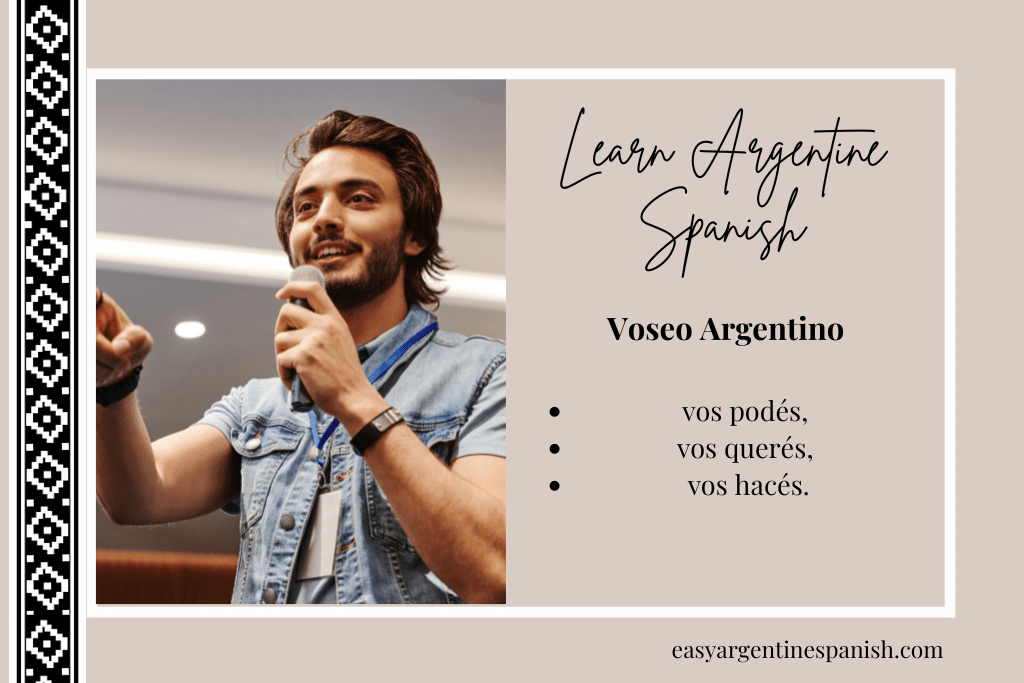
In Argentina, the use of ’vos’ is widespread. Contrary to what Natalia said about the Chilean voseo, Argentinians use ‘vos’ in both formal and informal situations. Argentines don’t use ‘tú’ at all, although it might be seen in some books and documents.
Another key difference is the conjugation of ‘vos’. It seems that Chileans conjugate verbs for the ‘vos’ pronoun in the same way as Spaniards conjugate verbs for the second person plural ‘vosotros.’
A. Vosotros habláis (Spain)→ Vos habláis → -ais → Tú hablái (no ‘s’) (Chile)
B. Vosotros tenéis (Spain) → Vos tenéis → -éis → Tú tení (aspirated ‘s’) (Chile)
C. Vosotros vivís (Spain) → Vos vivís → -ís → Tú vivís (aspirated ‘s’) (Chile)
Argentinians have not taken this too far from Spain’s ‘vosotros’ either:
A. Vosotros habláis (Spain)→ Vos hablás → -ás (no ‘i’) (Argentina)
B. Vosotros tenéis (Spain) → Vos tenés → -és (no ‘i’) (Argentina)
C. Vosotros vivís (Spain) → Vos vivís → -ís (no changes) (Argentina).
Here’s another blog post to learn more about the use of ‘vos’ in Argentina.

2) What are 10 of the most “weird” but commonly used words in Chile?
1. Po: This is the best way to spot a Chilean. It’s used to emphasize ideas. It’s not the same as saying “Sí” versus “Sí, po.” We use it to stress that we really do or don’t want something. In the latter case, it would be “No, po.”(“Po” is a filler word used for emphasis, not translatable but often used in English like “man” or “well”).
2. Cachái: It’s said to come from the English “to catch” and means “Do you understand?” → “¿Me cachái?” (Do you get it?). It can also mean “Can you imagine?” → “¿Te cachái?” (Can you imagine?).
Or even “look” in the imperative → “Cacha ese gato detrás tuyo” (Look at that cat behind you)… and “realize” → “No caché que no tenía comida, tendré que ir al supermercado.” (I didn’t realize I didn’t have any food, I’ll have to go to the supermarket.) I could go on, but “pa’ qué po?” (but why bother?)
3. Ma’encima: The second easiest way to recognize a Chilean is by their use of this expression, which should actually be “encima.” But in Chile, everyone (including me) says “más encima” when we mean: “To make matters worse.” For example: “Me dejó plantada y más encima después me pidió plata.” (He stood me up and, to top it off, then asked me for money.) It’s not officially accepted, but it’s very Chilean.
4. Altiro: It means right now or immediately, but it’s not the same as “ahorita” used elsewhere in Latin America. “Altiro” always has a sense of urgency: “Mándame el email altiro.” (Send me the email right away.)
5. Fome: It has two meanings. One is “boring.” For example: “¡Qué fome la película!” (The movie was so boring!) And the other meaning is “what a pity.” For example: “¡Qué fome lo que te pasó, amiga!” (What a pity about what happened to you, my friend!)
6. Guata: Comes from Mapudungun (the language of the Mapuche people, the largest indigenous group in Chile) and means stomach. “Me duele la guata.” (My stomach hurts.)
7. Poto: Also from Mapudungun, and means butt. “Tengo el poto cuadrado” (I’ve got a sore butt) (after sitting in a chair for a long time).
8. Pololo/a: It generally means “boyfriend” or “girlfriend.” In Chile, “novio” can be used for more formal or serious relationships, but “pololo” is commonly used in everyday conversation, regardless of how serious the relationship is. For example, even if you’ve been together for years and live together, you might still use “pololo” to refer to your partner.
9. Quiltro: A mixed-breed dog. “Mi quiltro se llama Toby.” (My mixed-breed dog’s name is Toby.)
10. Weón: I could go on about this word forever, but here are three examples:
a. As a noun: “weá” is basically anything. Yes, you can replace the noun “thing” with “weá.” (“Weá” is a slang term for “thing.”)
b. As an adjective: depending on the context, it could mean “friend” or “idiot.” (It can mean
“friend” or “idiot” depending on context.)
c. As a verb: it can mean “to waste time” → “Estuve puro weviando.” (I was just wasting time.) Or having a good time → “Hueviamos toda la noche.” (We had a blast all night.)
Oh, and you can spell it in various ways. But if you want to get to know this word and four others better, join my newsletter and get my audio guide where I teach you the 5 worst words in Chilean Spanish that never go out of style and will help you survive Chile and Chileans.
Subscribe for More Chilean Spanish
Click here to subscribe to the newsletter of Español Casi Perfecto.
I know all these words might be blowing your mind, but trust me, they’re part of our cultural identity and you’ll hear them all over Chile. You’ll get used to them in time—you’ll nail it!

2.1 )Are any of these Chilean words used in Argentina?
No. This doesn’t mean that we can’t communicate with our Chilean neighbors. However, there might be some confusion as we speak.
Here’s a comparison of what we would say instead, in Argentina:
-Po (for emphasis)→ Obvio
-Cachai (to understand) → ¿Me entendés?
-Ma’encima (on top of it all) → Y encima / Para colmo
-Altiro (right away) → Ya
-Fome (boring) → Embole/Bodrio
-Fome (pitty) → Bajón (similar to ‘a downer’)
-Guata (belly) → Panza
-Poto (butt) → Traste
-Pololo/a (bf, gf) → Novio/a
-Quiltro (mixed-breed dog) → Cruza/Perro marca pichicho
-Weón/a (friend or idiot) → Boludo/a
-Weviar (to waste time) → Boludear
In this article you can learn the most popular slang words from Argentina’s Lunfardo (our local slang).
3) In Buenos Aires, we pronounce ‘y’ and ‘ll’ as /sh/, does that happen in Chile? Are there any different sounds?
It’s funny because that sound is pretty stigmatized in Chile. So much so that for words like “sushi” (which clearly doesn’t come from Chilean Spanish), we tend to use a sound closer to /tʃ/ (like in “chico”). For example, instead of saying /’suʃi/, many people say /’sutitʃi/.
This shows how the /ʃ/ sound isn’t common or well-regarded in everyday Chilean speech, though you might still find people using it here.
In Chile, ‘y’ and ‘ll’ are generally pronounced as a soft /ʝ/, which is similar to the “y” in “yo” or “ll” in “llama” in other Spanish-speaking parts of the world. However, in some regions, especially in the north, you might hear a variant closer to /ʒ/, like the French “j” in “journal,” though this sound is also a bit stigmatized.
What’s definitely notable in Chile is the pronunciation of the “s” at the end of syllables or words. It’s common for us to aspirate it, meaning it sounds like a soft /h/, but we never drop it completely. For instance, in words like “más” or “las,” many Chileans will say something like “mah” or “lah.”
On the bright side, Chile’s phonetic and grammatical variation in Spanish is much less marked compared to the Spanish spoken in Argentina, where accents are way more pronounced.
So, not too bad after all, right?
Summary
In summary, if you’re wondering how is Argentinian Spanish different from Chilean Spanish, the key differences lie in pronunciation, vocabulary, grammar, intonation, and slang.
These variations make each dialect unique and enrich the cultural tapestry of the Spanish language.
Whether you’re planning to visit Argentina or Chile, understanding these differences will enhance your communication and appreciation of the local language.